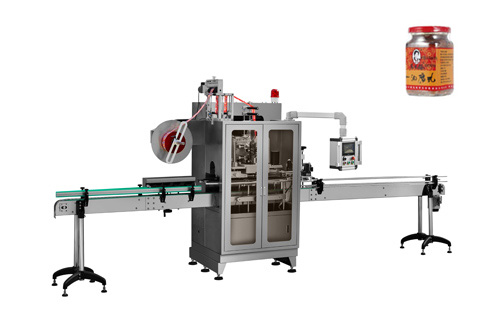
Shrink Sleeve Labeling Machine for Hot Sauce Bottles
A shrink sleeve labeling machine for hot sauce bottles must therefore be evaluated not only on speed, but on its ability to work reliably under these conditions.
Surface cleanliness is a common issue. Oil film or condensation on the bottle can cause the sleeve to slide slightly before shrinking, leading to rotated graphics or uneven coverage. Bottles should be dried and cooled after washing and filling, and the applicator should be positioned so that containers reach the labeling station without recontamination. Guide rails and star wheels also need to grip the bottle firmly without marking the glass.
Bottle geometry adds another layer of difficulty. Many hot sauce bottles have a narrow neck, a tapered shoulder, and a wider body, which requires the sleeve to shrink unevenly across different diameters. The film shrink ratio, tunnel temperature zones, and conveyor speed must be matched to this profile. If the neck area shrinks too quickly, wrinkles or necking may appear; if the body shrinks too slowly, the label may look loose.
Product temperature also matters. Hot sauce is often bottled at elevated temperatures, and residual heat can soften the film before it fully conforms to the bottle. Allowing containers to cool to a stable temperature before labeling improves shrink uniformity and reduces the risk of deformation. In some lines, a short cooling section between capping and labeling is more effective than adjusting the shrink tunnel alone.
For producers, testing should use actual filled bottles from the normal production flow, including bottles taken directly after filling and capping. Evaluating label rotation, shrink quality, film waste, and changeover time under these real conditions gives a more accurate picture of performance. When the machine is matched to the specific bottle and product characteristics, the labeling process becomes stable and repeatable.
 ∷